Showing posts with label Somme Woods. Show all posts

Monday, December 31, 2012

Winter jaunts

Ahh, winter break.  I've managed to take some time off from lounging on the couch (in an attempt to ignore this mysterious headache that's been torturing me for days by watching old movies on cable) and get my caboose out the door.  The fresh air has helped a little.  Then I go back inside and hunker miserably under a down throw and whimper a little.  Most of the time, I feel I would be a scrappy, survivalist fighter when the inevitable zombie apocalypse or devastating plague arrives.  In this current funk, I'm pretty sure I'd get my sissy, myopic ass beaten to a pulp and the brains sucked out of my skull.

 The first trip was the day after school got out--my field trip to the North Branch solstice bonfire.  Sixteen of my best and brightest came out on a Saturday morning on winter break, without receiving any reward of extra credit or service-learning hours, to hang out with their teacher in the woods on a cold day.  Kids these days--they're not all lazy bums.  We hiked around Somme Prairie Grove for a couple of hours, then headed over to Somme Woods for the bonfire.  It's delightfully pagan, what with the bagpiper and drummer and flutes and all.


I also shot some videos, with the club's little flip-cam purchased with Climate Cycle funds.  I am not an accomplished cinematographer, as evidenced by the vomit-inducing video I captured of the bagpipe procession from the parking lot to the woodpile.  Not a good idea to videotape while walking a rugged woodland path, it turns out.  Instead, I will treat you with a short clip of the bonfire in full flame:


Next trip:  Christmas Bird Count at Gensburg-Markham Prairie (not on actual Christmas, but 12/29).  I have always wanted to do a CBC, but never quite got around to it, due to sheer laziness and lack of confidence in my birding skills.  This year, despite the snow showers, I decided to sack up and go, figuring I could just keep notes for the experienced birders and absorb some expertise from them, like a leech.  The bird show was, well, underwhelming.  I was easily able to ID the few species we saw, and actually was the first one in the group to pin down the ID of a flock of sparrows...American tree sparrows.  Other than that, there were a couple of flocks of Canada geese flying overhead, a pair of red-tails, a few crows, and a ring-billed gull.  Yawn.  The joint was eerily silent in the snow, except for the distant roar of traffic from I-294.  Beautiful lighting for photos, however.  It was a damned shame my fingers were so cold and I brought my small camera whose settings I still haven't bothered to figure out.  Despite this, I got some good shots of cream false indigo in its subtle winter colors, and a neat shot of the burned vs. unburned side of the firebreak:


Last outing:  workday at Bunker Hill yesterday, 12/30.  This was my and Rebecca's first stint as apprentice stewards.  It went acceptably well.  There was some grumbling, bumbling, and passive-aggressive jabs from the volunteers at the outstart, since we did not plan to burn brush piles and it was rather nippy at 9am.  The reason for this is that Bunker Hill is in the confrontational zone, where the anti-restorationists have their last meager foothold.  The special rule for this zone is that any brush piles have to be out cold--not just flame-free, glowing embers as at the other sites, but cold enough to sit on--before you leave.  This means either sticking around until sunset to let the coals burn out, or putting the fire out with snow or river water (which is undesirable in that it leaves permanent piles of charcoal that will stick around for decades, as opposed to piles of fluffy ash that dissipate in the wind).  I didn't want to leave a legacy of charcoal at my new site, so we opted instead to drag all the brush to the bike path and leave it for the district to put in the chipper.  This warmed everyone up pretty quickly, so things were friendlier after the first half hour.  We only had visits from 3 of the antis, who stood out on the bike path and accosted walkers and joggers with their misinformation campaign, but kept rather quiet relative to the noisy, offensive protests of their heyday.  Since I was busy keeping the show running, I just got a couple of post-mayhem shots...the little oak grove we cleared the buckthorn and ash saplings out of, and one of the impressive piles of brush waiting to be chipped:


May the new year bring more and better opportunities for nature-gazing...including my upcoming Lincoln's bday trip to Florida, spring break to see the sandhills in Nebraska and backpack in national parks farther west, and--dare I jinx myself?--possibly Thailand and/or Central America this summer?  I wipe my hands of you, 2012, and good riddance!

Saturday, September 29, 2012

Asters & Goldenrods

Last weekend, I was finally able to come up for air from my job and get outside.  Outside into the woods and grasslands, to be specific; I spent the great majority of the previous two weeks outside in the beautiful September sunshine, but while walking the picket line on the teachers strike and attending rallies around my great city.  It was a great experience in active democracy, despite being exhausting.  Standing around in the sun and the wind and exhaust from the six lanes of traffic on Pulaski was strangely more draining than being in the classroom all day.  But I guess that would not be surprising to many, since it is widely held we have an easy, plum job for which we are overpaid.  But enough with the grumpies!  Let's talk about those delightfully nasty fall specialties, the asters and goldenrods.
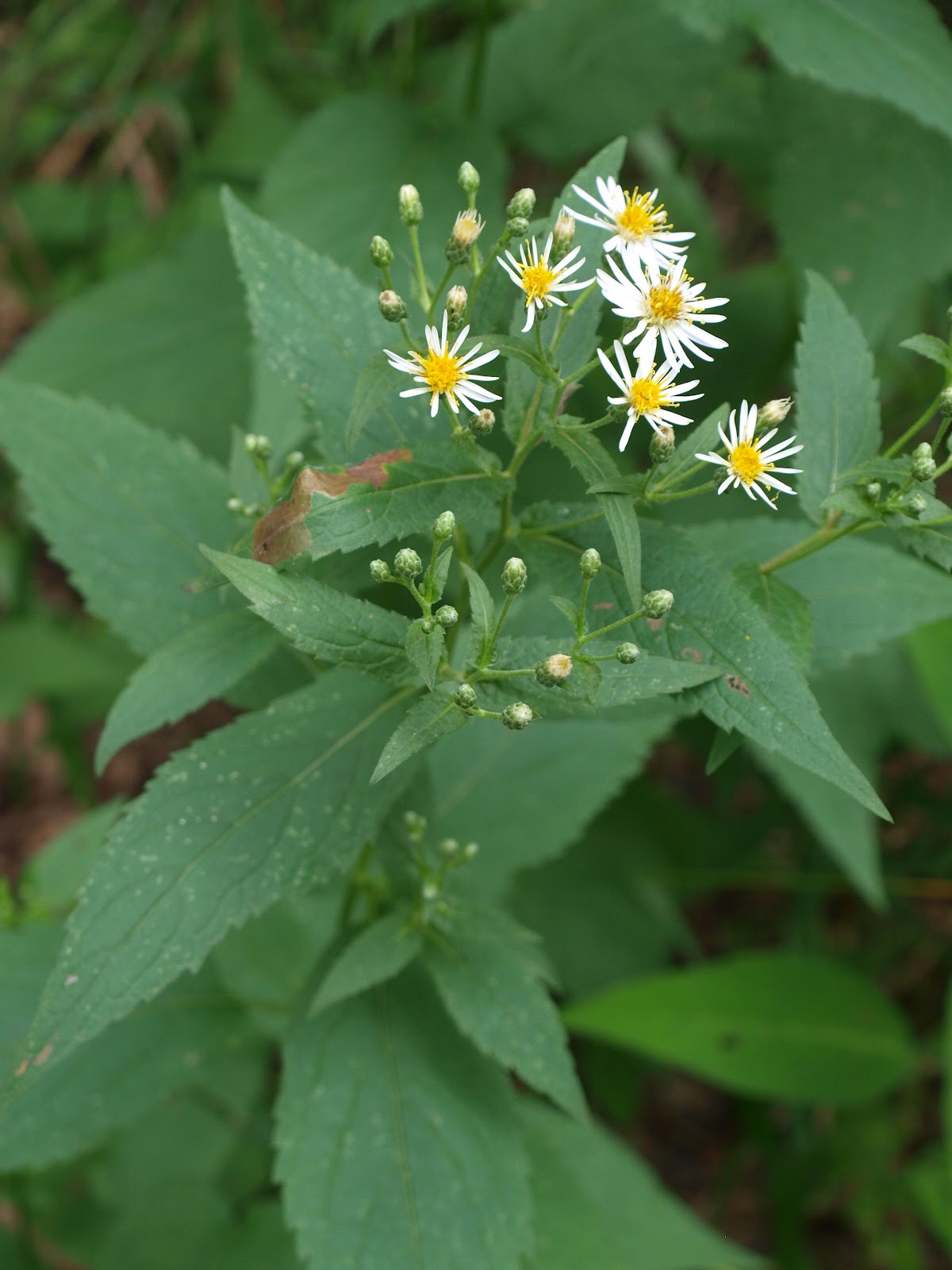
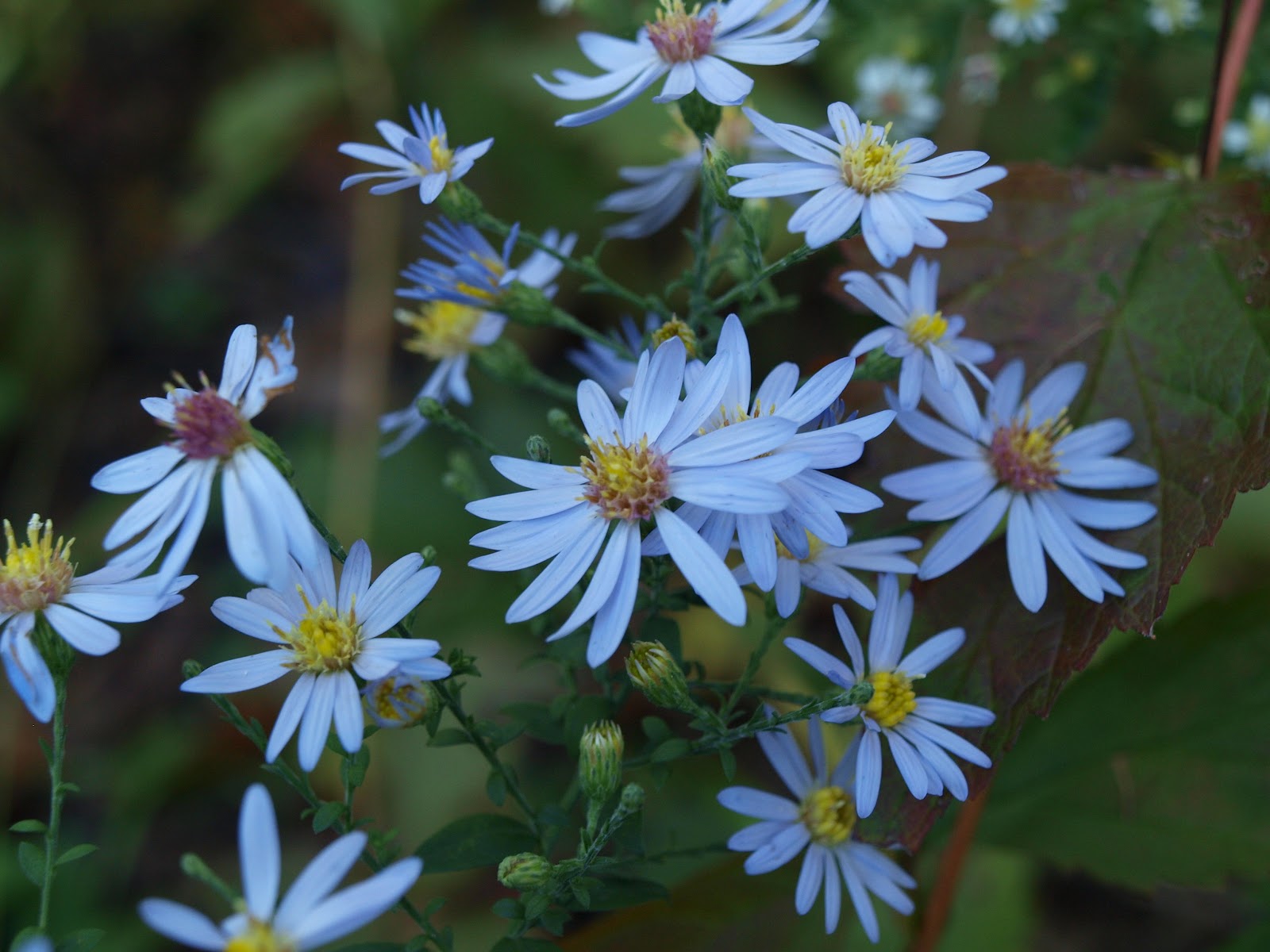
Elizabeth & I headed out to the Sommes on a gorgeous Sunday morning, armed with our Swinks and a lofty ambition of becoming more familiar with those populous genera.  I was feeling pretty confident, having received a rundown on them during one of the more recent botany walks.  'Tis folly to be confident in the Asteraceae, I have come to realize.  We were able to figure out most of them, and I became able to distinguish a couple of my nemeses, A. shortii and A. sagittaria drummondii.  They really don't look that much alike, aside from both being pale lavender and blooming at the same time, but I usually forget from fall to fall which is which.  However, by the time we reached the southwest corner of SPG, where some huge trees were cleared a few years back, we became frustrated by a few confusing asters and accepted defeat.  I have also come to realize that I am perplexed by hairy aster, A. pilosus, and think everything is it.  As a botanist, I am rubbish [said with a British accent].

Here is a list of asters and goldenrods we saw, or at least think we saw:
Aster lateriflorus, shortii, sagittaria drummondii, laevis, azureus, furcatus, novae-angliae, praeltus, umbellatus, ericoides, pilosus, ontarionis (suspected);
Solidago caesia, ulmifolia, rigida, graminifolia, riddellii, gigantea, speciosa, rugosa, nemoralis, canadensis (blech).

The photos...some of the earlier-blooming ones were in sorry shape, so I have no photos.  I've thrown in some photos of other fall lovelies, because it's not their fault they're not in the star genera:
 Aster azureus, sky-blue aster

 Aster ericoides, heath aster

 Aster furcatus, forked aster

 Aster laevis, smooth blue aster

 Aster lateriflorus, side-flowering aster

 Aster novae-angliae, New England aster

 Allrighty.  This is the stumper.  We hesitatingly dubbed this Aster ontarionis, Ontario aster.  The key in this section of the asters is brutal.  It could also maybe be A. simplex, but it just didn't look that simplex-y to me.

 Here's a closer look at it.

 Aster pilosus, hairy aster.  At least I think it is.  Like I think every nondescript white aster is.

 Aster praeltus, willow aster.  It has a fleshy gestalt.

 Aster sagittaria drummondii.  Elizabeth pointed out the winged petioles which are an indicator.  Hopefully I'll stop messing it up.

 Here it is again, with flowers.  Short, stubby little petals.

 And here is what I always confuse it with, Aster shortii, Short's aster.  It has longer petals and less numerous flowers.

 A. shortii's leaves are "very neat", according to another botanist friend, Karen.  

 Aster umbellatus, flat-topped aster, looking a little blowsy and used-up this late in the season.

 A little intermission, brought to you by the Gentianaceae.  Check out the stripes in the throat of Gentiana crinita, fringed gentian!

 Gentiana quinquefolia, stiff gentian.  The gentians are beautiful, but they make me sad--the harbingers of the death and cold misery to come.  I will never be one of those people who look forward to crisp fall weather. 

 And we're back!  Solidago caesia, blue-stemmed goldenrod, with its ghostly, pale blue stem.

 Solidago nemoralis, old-field goldenrod.  I think that name is more romantic than its other, gray goldenrod, although you can definitely see in this photo where that name comes from.

 Solidago riddellii, Riddell's goldenrod

 Solidago rigida, stiff goldenrod

 Solidago speciosa, showy goldenrod.  It looks like a fairy wand to me.

 Solidago ulmifolia, elm-leaved goldenrod, whose leaves look nothing like elm leaves.  As an earlier-blooming goldenrod, it's a little past its prime.

Aaaaand Triosteum aurantiacum, orange-fruited horse gentian, whose specific epithet I've been mispronouncing for years.  I was gently corrected this summer.

I'll leave you with a photo of one of the prairie openings at SPG...I walked through it with my arms brushing the tops of the Indian grass, like Kevin Costner in Dances With Wolves:


Thursday, August 2, 2012

Plant monitor training! (Less boring than it sounds)

Maybe we do need to come up with a better name for it--"plant monitor training" doesn't really do it justice.  Karen at Audubon-Chicago Region has been coordinating a series of botany outings, in order to cultivate more highly-skilled botanists in the area, so that we potentially have more capable plant monitors in the event of a future natural areas audit, like the Chicago Wilderness and Grassland audits a few years back.  Not plant monitors like the single-species monitors for Plants of Concern; not to knock them, of course (I am one myself), but monitors with a wide range of knowledge.  This is sorely needed, because let's face it:  the skilled botanists are aging, and it's not exactly the cool thing that kids like to do these days. 

Our first outing of the season was at Somme Woods on 7/29, led by Somme stewards Linda Masters and Stephen Packard.  We had originally intended to go to Somme Prairie Grove across the street, but we parked at Somme Woods and encountered so many wicked species, we never made it out.  I rescind all former statements that the woods are boring in July.  Healthy, open, restored woods give you knockouts like these:

 Lobelia cardinalis, which attracted a very mild-mannered ruby-throated hummingbird (just LOOK at those little nectar-baits!)

 Glade mallow (my first reaction:  Why does that maple seedling have white flowers?)

 The very overlook-able marsh bluegrass

 Ranunculus flabellaris, known to some as floating yellow buttercup (or some permutation of those terms), which was found covering the floor of the completely dry Eagle Pond

 Sium suave (water parsnip), not to be confused with its cousins-in-close-proximity cowbane and water hemlock

 The tiny state-threatened gem, marsh speedwell

 Carex squarrosa...there's no mistaking this one.


 Purple Joe-Pye weed...lighter in color than its cousin spotted Joe-Pye, and of course, lacking spots on the stem.

 Floating manna grass--very simple and understated.  Like the honey badger, Glyceria septentrionalis don't give a shit.

 Lactuca floridana, or tall blue lettuce.  Someday I will memorize this name. 

 Carex lupuliformis, with its bizarre knobby little seeds.  Who knows how long I've been seeing this and thinking it was its close relative, Carex lupulina.  Botany is humbling.


 Flat-top aster.  Not many whites are brighter than this.

Aaaaand...forked aster.  Not visibly forked in any perceptible way, but whatever.  It's being proposed as a federally endangered species.  It can be called whatever it wants.

Let's clear those woods, ladies and gentlemen!