Showing posts with label Gensburg-Markham Prairie. Show all posts

Monday, December 31, 2012

Winter jaunts

Ahh, winter break.  I've managed to take some time off from lounging on the couch (in an attempt to ignore this mysterious headache that's been torturing me for days by watching old movies on cable) and get my caboose out the door.  The fresh air has helped a little.  Then I go back inside and hunker miserably under a down throw and whimper a little.  Most of the time, I feel I would be a scrappy, survivalist fighter when the inevitable zombie apocalypse or devastating plague arrives.  In this current funk, I'm pretty sure I'd get my sissy, myopic ass beaten to a pulp and the brains sucked out of my skull.

 The first trip was the day after school got out--my field trip to the North Branch solstice bonfire.  Sixteen of my best and brightest came out on a Saturday morning on winter break, without receiving any reward of extra credit or service-learning hours, to hang out with their teacher in the woods on a cold day.  Kids these days--they're not all lazy bums.  We hiked around Somme Prairie Grove for a couple of hours, then headed over to Somme Woods for the bonfire.  It's delightfully pagan, what with the bagpiper and drummer and flutes and all.


I also shot some videos, with the club's little flip-cam purchased with Climate Cycle funds.  I am not an accomplished cinematographer, as evidenced by the vomit-inducing video I captured of the bagpipe procession from the parking lot to the woodpile.  Not a good idea to videotape while walking a rugged woodland path, it turns out.  Instead, I will treat you with a short clip of the bonfire in full flame:


Next trip:  Christmas Bird Count at Gensburg-Markham Prairie (not on actual Christmas, but 12/29).  I have always wanted to do a CBC, but never quite got around to it, due to sheer laziness and lack of confidence in my birding skills.  This year, despite the snow showers, I decided to sack up and go, figuring I could just keep notes for the experienced birders and absorb some expertise from them, like a leech.  The bird show was, well, underwhelming.  I was easily able to ID the few species we saw, and actually was the first one in the group to pin down the ID of a flock of sparrows...American tree sparrows.  Other than that, there were a couple of flocks of Canada geese flying overhead, a pair of red-tails, a few crows, and a ring-billed gull.  Yawn.  The joint was eerily silent in the snow, except for the distant roar of traffic from I-294.  Beautiful lighting for photos, however.  It was a damned shame my fingers were so cold and I brought my small camera whose settings I still haven't bothered to figure out.  Despite this, I got some good shots of cream false indigo in its subtle winter colors, and a neat shot of the burned vs. unburned side of the firebreak:


Last outing:  workday at Bunker Hill yesterday, 12/30.  This was my and Rebecca's first stint as apprentice stewards.  It went acceptably well.  There was some grumbling, bumbling, and passive-aggressive jabs from the volunteers at the outstart, since we did not plan to burn brush piles and it was rather nippy at 9am.  The reason for this is that Bunker Hill is in the confrontational zone, where the anti-restorationists have their last meager foothold.  The special rule for this zone is that any brush piles have to be out cold--not just flame-free, glowing embers as at the other sites, but cold enough to sit on--before you leave.  This means either sticking around until sunset to let the coals burn out, or putting the fire out with snow or river water (which is undesirable in that it leaves permanent piles of charcoal that will stick around for decades, as opposed to piles of fluffy ash that dissipate in the wind).  I didn't want to leave a legacy of charcoal at my new site, so we opted instead to drag all the brush to the bike path and leave it for the district to put in the chipper.  This warmed everyone up pretty quickly, so things were friendlier after the first half hour.  We only had visits from 3 of the antis, who stood out on the bike path and accosted walkers and joggers with their misinformation campaign, but kept rather quiet relative to the noisy, offensive protests of their heyday.  Since I was busy keeping the show running, I just got a couple of post-mayhem shots...the little oak grove we cleared the buckthorn and ash saplings out of, and one of the impressive piles of brush waiting to be chipped:


May the new year bring more and better opportunities for nature-gazing...including my upcoming Lincoln's bday trip to Florida, spring break to see the sandhills in Nebraska and backpack in national parks farther west, and--dare I jinx myself?--possibly Thailand and/or Central America this summer?  I wipe my hands of you, 2012, and good riddance!

Monday, November 12, 2012

Partial burn

I was so excited...finally, a prescribed burn taking place on a non-school-day!  Saturday was a bizarrely warm and stunning November day, and I was invited to join the burn crew at Gensburg-Markham Prairie.  It should have been quick and straightforward--a rectangular burn unit, simple ring fire, steady southwesterly winds.  Usually burn season takes place in the chilly part of the year, so that you are shivering in your Nomex jumpsuits before the fire gets going, but that day we were all comfortable in a single layer.  Here is my "Before" shot, taken from the northeast corner, with the intention to take an "After" shot from the same location.  It did not happen that way.  Looked like a lovely day, no?


This is the beginning of the back fire, lit at the same northeast corner.  For the uninitiated, you let the fire fight back slowly against the wind, keeping the mowed fire break hosed down along the downwind side, to keep the fire from burning out of your control.


My half of the crew crept slowly along the eastern edge of the burn unit...a surprisingly painstaking process.  The fire desperately wants to swallow up the fire-loving bluejoint grass, but the opposing wind keeps it in check.


 The fire inches its way inward, widening the fuel-less safe zone.  Interesting skies we have there to the west.


A close-up of the flames.  They're mesmerizing.  Occasionally the wind would die down, allowing the fire to roar up and consume the grassy fuel.  


Huge water tanks, backpack sprayers, and flappers stand ready to smite any stray embers.


The skies become increasingly ominous as the blackened strip widens.


The first raindrops from the thunderstorm (unpredicted by any of the forecasts) started to fall when we were almost ready to make the turn to the south end of the unit, where we would have set the head fire that would race northward with the wind, gobbling up the grasses until it met up with the blackened strip, extinguishing itself for lack of fuel.  The grass became too wet to burn, the flames petering out as soon as the drip torch dripped them out.  We had to put the kibosh on the burn, doubling back to snuff out the dying flames.  The line of thunderstorms hit us right after that:


Such a bummer!  I've dealt with snowflakes during a burn, but being rained out is a new thing.  I'm not usually too quick to blame global climate change for weird weather...one day of weird weather goes down as an anomaly in my book.  It drives me nuts when a cold snap brings out the global warming deniers, or a heat wave sends everyone into a frenzy.  But there's been an awful lot of weird stuff lately, perhaps too much to be considered anomalies.

But never fear...even though we had to abort our mission, the prairie will get burned eventually.  All they need is a few days to dry out, a clear day, and another southwesterly wind.  The hard part has already been done--all they need to do is set the head fire screaming across the prairie.

[Side note:  It has been brought to my attention that perhaps people are commenting on these entries; as far as I can see, there are none.  So forgive me if I do not reply--technical errors may be occurring.]

Saturday, August 18, 2012

Solo Bender: Sandy Soil Sites of South Cook

I had nothing on my calendar yesterday, so I took a little tour of the ol' lake plain, checking out some preserves in southern Cook County.  Four of them, to be exact.  Here is the scoop:

#1:  Sand Ridge Nature Center.  One might assume that something called a "nature center" might have some respectable nature in its boundaries.  I am slowly coming to the realization that "nature center" is synonymous with "dump in which your children can run wild without harming anything".  The nicest thing I can say about this place is that it had an indoor bathroom.  Every "natural" area in the joint seemed highly impacted by humans and full of nonnatives.  I set out along the Lost Beach loop trail, figuring hey, it's only two miles, so even if it sucks I'll get some decent exercise and I'll still be out of here in half an hour.  At one point, while still on the spur trail to the loop part of the trail, I stopped and turned around, my skin crawling from the walls of buckthorn and other nasties looming above me, and had to persuade myself to keep going.  I then reached the loop, which had a solid understory of buckthorn.  (For some reason, when I first saw the name "Sand Ridge", I was expecting nice open sand prairie.  Ha ha ha, I'm so naive!).  I turned around for good and got the hell out of there.  Maybe there were actually some nice ancient beach ridges farther along, but I was not going to get my hopes up.  On the way out, I used the bathroom again for good measure.  Take that, FPDCC!  Here are the only decent shots I got:
Phytolacca americana, pokeweed.  It's actually kinda pretty before it becomes a huge bulky purple-berried monster.

Polygonum sagittaria, arrow-leaved tearthumb, with the cartilaginous, retrorse, thumb-tearing prickles evident

#2:  Sand Ridge Nature Preserve.  This is just to the east of the nature center, one of those preserves they don't really label because they don't want you going there.  #39 on my all-time list of Illinois Nature Preserves (that's a tally, not a rank...I can surely think of worse ones).  You can just park at the Burnham Greenway Trail along 184th St. and walk down Campbell Street, which goes right through the preserve.  Then, take a deep breath and plunge into the tall, rank vegetation.  That poor place...the INPC listing has all of these great species listed, but it's been swallowed whole by monstrous hordes of tall goldenrod, purple loosestrife, and cruel brambles.  It would benefit from repeated catastrophic wildfires.  I saw a few prairie species here and there, and there are still oak trees lined up on the old beach ridges; otherwise, you would not be able to tell where they were.  Anyone wishing to visit this place would do well to wear heavy-duty Carhartts, and NOT lightweight, quick-dry zipoffs as I did, unless you wish to be shredded to bits by the brambles.  As I was.  I staggered out of that place with about as much relief as I did the nature center.  Photographic evidence of this arduous journey:

One of the swales between ridges...chock full of purple loosestrife.  Sigh.

 Coreopsis tripteris, or tall coreopsis, with a nice oak ridge in the background.  Just ignore all the tall goldenrod in the low background.

 Spartina pectinata--prairie cord grass.  I love the striping on the sheath.  (And one nice thing I'll say about loosestrife--it forms a nice Monet-like background!)

 Check it out--I ID'd a dodder!  This one is rope dodder, Cuscuta glomerata.  According to Swink & Wilhelm..."This species can be identified at 10 paces by its distinctive appearance as a section of white rope wound in several spiral turns around the stem of its host."  Ah, yep.  That's it.  This dodder was ALL OVER the place, strangling the crap out of the tall goldenrod (but apparently not enough to control it).  Kick some ass, rope dodder!

Here it is again.  It is the ball python of the plant kingdom.

#3:  Zanders Woods.  Dear, sweet Zanders Woods.  The perfect antidote to the previous sites.  The air is always cool and fresh here, and smells better than any other place I know in the Chicago area.  The INPC gives it the rather unpoetic name of Thornton-Lansing Woods, but I prefer the more common FPDCC name.  It sounds like the strumming of a harp.  I didn't spend too much time here, because time was ticking toward Friday rush hour; just enough to check out the little sand prairie opening off the west side of the access road that is always full of delightful things that the FPDCC hasn't managed to neglect to death yet.  I was a little troubled to see a strange infestation in the prairie...common ragweed.  It covered a good third or so of the prairie, which is a pretty rapid colonization--I don't remember seeing it when I was there last, about two years ago.  That's not something one usually sees in high quality areas; usually it sticks to old-fields and roadsides.  But the place was in pretty good shape, otherwise; it had the wonderful problem of being so nice, it was difficult to find places to step.  Here are some of the denizens managing to tough out the drought:

 Aster simplex, panicled aster.  Showing off its panicle.

 Arenaria lateriflora, grove sandwort.  One day, I will get over my fear of technology and figure out how to adjust the exposure so the whites aren't washed out.
This is NOT Arenaria.  I don't do drugs, so maybe someone spiked my food the day I wrote this.  It is a chickweed of some sort, I believe.

Solidago juncea, early goldenrod.  Fireworks!

#4:  Gensburg-Markham Prairie.  It's pretty much gone into shut-down mode: a sea of green and brown, interrupted by a few isolated splashes of yellow from some warrior-like rosinweed and early goldenrod.  I could almost feel them gloating over their less-deeply-rooted neighbors.  Maybe because of this lack of flowers, the few I did see were absolutely swarmed with insects:

 Bull thistle may be a nasty nonnative, but the bugs ain't picky.  They were trembling with joy over these pom-poms.  A big fuzzy bumbler cavorted with a couple of pairs of milkweed bugs in flagrante delicto.  Speaking of which, aren't those bugs just the horniest bugs out there?  I swear I see them more often stuck together in pairs than I see them alone.

A cicada killer cricket hunter (?) on whorled milkweed.  They were all over those like white on rice.  [Someone long ago told me these were cicada killers.  I just looked it up, and cicada killers are actually those fat wasps with stripy abdomens.  I think these blue guys are from the genus Chlorion, based on a quick internet search.]

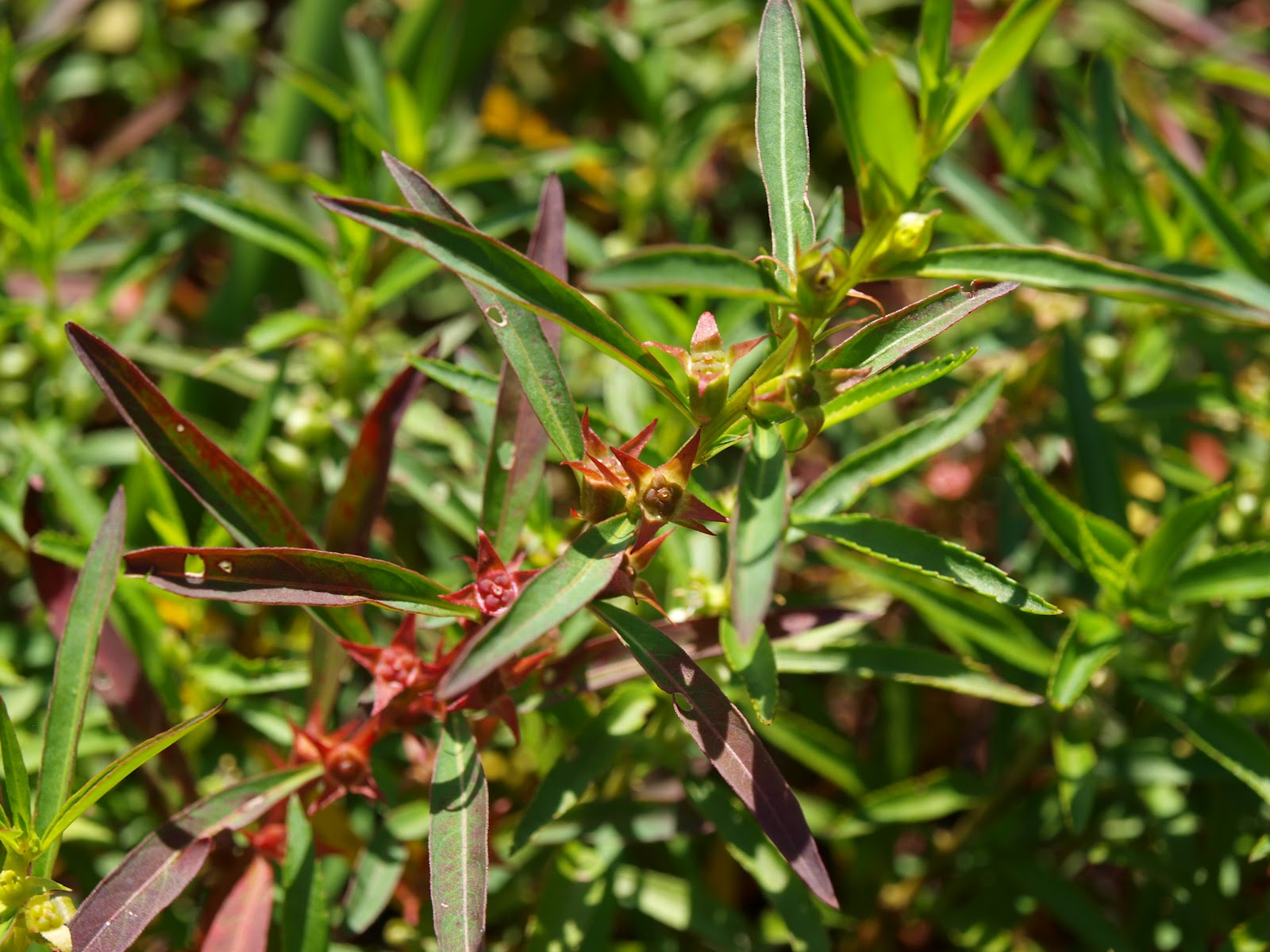
 All right, I'm pretty sure this is Ludwigia polycarpa, false loosestrife.  I didn't key it out.  I'm sure certain people who work there would be able to tell me.  There was a whole big wetland area near the north side of the loop that was a monoculture of this stuff.  It was a little spooky, honestly.

 I really need to be more diligent about keying stuff out in the field.  I snapped a photo of this, from the man-made ditch along the north side, fairly certain it was large-flowered water plantain, Alisma triviale.  That's because I'm a cocky know-it-all who in actuality knows jack.  Could it really be Sagittaria rigida, stiff arrowhead?  That's what the key leads me to, but it is a C=10 with no voucher specimen in Cook County.  What would it be doing in that slummy place?  Again, employees of IBP, help me out here.

And the grand finale, a big ol' clump of rosinweed singing its lungs out in the afternoon sun!