Every quarter since I began teaching, I have taken the kids out for restoration workdays in the forest preserves in order to get them some extra credit. That makes 16 workdays, and that doesn't even include workdays for my club or for other random service learning events. Perhaps 25 total. Today, the 17th quarter workday of my teaching career, was the first absolute, undeniable rainout of a workday. We've worked merrily through drizzle and 15 degree lows, snowflakes and blistering heat, but today the heavens unleashed upon us the most unholy downpour, after one hopeful hour in the field at Sundown Meadow. We were soaked, and temperatures were in the 50s, so I reluctantly had to call it. Luckily, I have a great batch of kids again this year (breaking the every-other-year bad batch curse, as last year's were great too), and they were in high spirits after being indulged with lots of processed sugar and simple carbs. Eh, it had to happen eventually.
This just means that the weather will be perfectly obliging next Saturday for our hiking trip to Illinois Beach. Right now, the forecast says 55 degrees and 0% of rain. Let's cross our fingers that it holds.
Saturday, October 13, 2012

Monday, October 8, 2012
Glacial relicts
One of the badges I wear as an outdoorswoman is that of Plants of Concern monitor for the Chicago Botanic Garden. We do annual studies of rare plants in the region to determine whether populations are declining or in trouble. I've been monitoring the Carex bromoides (brome hummock sedge) at Spicebush Woods for a few years, and agreed to start monitoring the Juniperus communis (the poorly named common juniper) at Harms Woods this year. I only agreed to this because since it's a conifer, it could be monitored pretty much any time of the year, unlike C. bromoides, which is in flower right smack dab in the middle of one of my busiest times of year--May, the season of AP field trips and end-of-school-year madness. I meant to get to it during my Summer of Nothing, but too much of the nothing got in the way. So here we are, monitoring it on a chilly October day. Despite the lovely sunshine, it was breezy and uncomfortable, as I was dealing a throbbing sinus infection and did not have the foresight to bring a pair of gloves with me. Juniper is tangly and prickly, and it scratched the hell out of my hands until I found an old pair of dirty socks in the trunk of my car to wear as clumsy mittens. The things I do for my friends in Kingdom Plantae...
Juniperus communis is a 10, according to Swink & Wilhelm. It's a creeping juniper shrub that is normally found on dunes around Lake Michigan, and is rare because that habitat has pretty much been urbanized. Harms Woods, for those in the know, is not a dune landscape near Lake Michigan. It's a flatwoods along the North Branch of the Chicago River, quite a ways west of the lake. So what in the dickens is this plant doing there? The colony I monitor is on a sandy bluff (if you can call the low banks of the Chicago River "bluffs" without laughing) over the river, and is most likely a boreal relict from the days of the last glacial retreat. It's hanging on in this unlikely spot along with some other rare pals from the olden days, now considered to be northern and/or dune specialties--Aster macrophyllus (big-leaved aster) and Maianthemum canadense (Canada mayflower). For whatever reason, this spot has remained cool and shady enough to allow these fossils to hang in there.


Juniperus communis is a 10, according to Swink & Wilhelm. It's a creeping juniper shrub that is normally found on dunes around Lake Michigan, and is rare because that habitat has pretty much been urbanized. Harms Woods, for those in the know, is not a dune landscape near Lake Michigan. It's a flatwoods along the North Branch of the Chicago River, quite a ways west of the lake. So what in the dickens is this plant doing there? The colony I monitor is on a sandy bluff (if you can call the low banks of the Chicago River "bluffs" without laughing) over the river, and is most likely a boreal relict from the days of the last glacial retreat. It's hanging on in this unlikely spot along with some other rare pals from the olden days, now considered to be northern and/or dune specialties--Aster macrophyllus (big-leaved aster) and Maianthemum canadense (Canada mayflower). For whatever reason, this spot has remained cool and shady enough to allow these fossils to hang in there.

The tiny juniper colony. Rebecca is counting stems, which is probably an exercise in futility. I am 99% sure that it is all one ancient plant, connected underground.

Up close, with its snazzy little pinstripes. We midwesterners don't get a lot of conifers, so we find them fascinating.

What is wrong with me? I stupidly decided not to bring Swink into the field with me, because I figured I would know all the associate species. Well, pride goeth before the fall. Damn you, closely-related viburnums! This is V. recognitum or V. rafinesquianum (one of my top-five Latin names!)...it comes down to petiole length. Does that petiole look shorter or longer than 1.2 cm? I'm leaning towards longer, which would make it the non-native recognitum. Bollocks.

A horizontal Aster macrophyllus, leaning out from the riverbank.

The trail on the hike out. Looks like a friggin' Thomas Kinkade painting!
Saturday, September 29, 2012
Asters & Goldenrods
Last weekend, I was finally able to come up for air from my job and get outside. Outside into the woods and grasslands, to be specific; I spent the great majority of the previous two weeks outside in the beautiful September sunshine, but while walking the picket line on the teachers strike and attending rallies around my great city. It was a great experience in active democracy, despite being exhausting. Standing around in the sun and the wind and exhaust from the six lanes of traffic on Pulaski was strangely more draining than being in the classroom all day. But I guess that would not be surprising to many, since it is widely held we have an easy, plum job for which we are overpaid. But enough with the grumpies! Let's talk about those delightfully nasty fall specialties, the asters and goldenrods.
Elizabeth & I headed out to the Sommes on a gorgeous Sunday morning, armed with our Swinks and a lofty ambition of becoming more familiar with those populous genera. I was feeling pretty confident, having received a rundown on them during one of the more recent botany walks. 'Tis folly to be confident in the Asteraceae, I have come to realize. We were able to figure out most of them, and I became able to distinguish a couple of my nemeses, A. shortii and A. sagittaria drummondii. They really don't look that much alike, aside from both being pale lavender and blooming at the same time, but I usually forget from fall to fall which is which. However, by the time we reached the southwest corner of SPG, where some huge trees were cleared a few years back, we became frustrated by a few confusing asters and accepted defeat. I have also come to realize that I am perplexed by hairy aster, A. pilosus, and think everything is it. As a botanist, I am rubbish [said with a British accent].
Here is a list of asters and goldenrods we saw, or at least think we saw:
Aster lateriflorus, shortii, sagittaria drummondii, laevis, azureus, furcatus, novae-angliae, praeltus, umbellatus, ericoides, pilosus, ontarionis (suspected);
Solidago caesia, ulmifolia, rigida, graminifolia, riddellii, gigantea, speciosa, rugosa, nemoralis, canadensis (blech).
The photos...some of the earlier-blooming ones were in sorry shape, so I have no photos. I've thrown in some photos of other fall lovelies, because it's not their fault they're not in the star genera:




Elizabeth & I headed out to the Sommes on a gorgeous Sunday morning, armed with our Swinks and a lofty ambition of becoming more familiar with those populous genera. I was feeling pretty confident, having received a rundown on them during one of the more recent botany walks. 'Tis folly to be confident in the Asteraceae, I have come to realize. We were able to figure out most of them, and I became able to distinguish a couple of my nemeses, A. shortii and A. sagittaria drummondii. They really don't look that much alike, aside from both being pale lavender and blooming at the same time, but I usually forget from fall to fall which is which. However, by the time we reached the southwest corner of SPG, where some huge trees were cleared a few years back, we became frustrated by a few confusing asters and accepted defeat. I have also come to realize that I am perplexed by hairy aster, A. pilosus, and think everything is it. As a botanist, I am rubbish [said with a British accent].
Here is a list of asters and goldenrods we saw, or at least think we saw:
Aster lateriflorus, shortii, sagittaria drummondii, laevis, azureus, furcatus, novae-angliae, praeltus, umbellatus, ericoides, pilosus, ontarionis (suspected);
Solidago caesia, ulmifolia, rigida, graminifolia, riddellii, gigantea, speciosa, rugosa, nemoralis, canadensis (blech).
The photos...some of the earlier-blooming ones were in sorry shape, so I have no photos. I've thrown in some photos of other fall lovelies, because it's not their fault they're not in the star genera:

Aster azureus, sky-blue aster

Aster ericoides, heath aster

Aster furcatus, forked aster

Aster laevis, smooth blue aster

Aster lateriflorus, side-flowering aster

Aster novae-angliae, New England aster

Allrighty. This is the stumper. We hesitatingly dubbed this Aster ontarionis, Ontario aster. The key in this section of the asters is brutal. It could also maybe be A. simplex, but it just didn't look that simplex-y to me.

Here's a closer look at it.

Aster pilosus, hairy aster. At least I think it is. Like I think every nondescript white aster is.

Aster praeltus, willow aster. It has a fleshy gestalt.

Aster sagittaria drummondii. Elizabeth pointed out the winged petioles which are an indicator. Hopefully I'll stop messing it up.

Here it is again, with flowers. Short, stubby little petals.
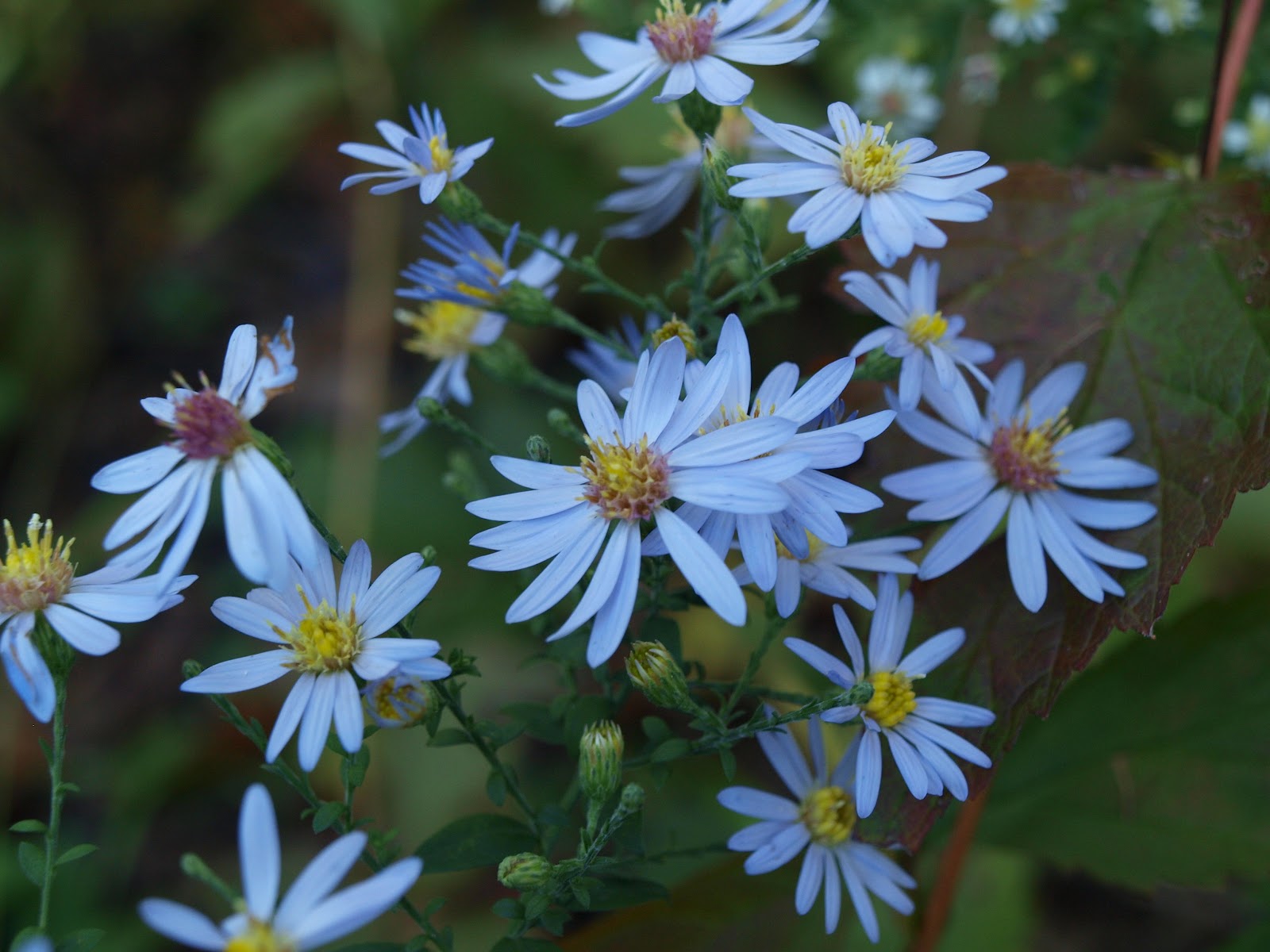
And here is what I always confuse it with, Aster shortii, Short's aster. It has longer petals and less numerous flowers.

A. shortii's leaves are "very neat", according to another botanist friend, Karen.

Aster umbellatus, flat-topped aster, looking a little blowsy and used-up this late in the season.

A little intermission, brought to you by the Gentianaceae. Check out the stripes in the throat of Gentiana crinita, fringed gentian!

Gentiana quinquefolia, stiff gentian. The gentians are beautiful, but they make me sad--the harbingers of the death and cold misery to come. I will never be one of those people who look forward to crisp fall weather.

And we're back! Solidago caesia, blue-stemmed goldenrod, with its ghostly, pale blue stem.

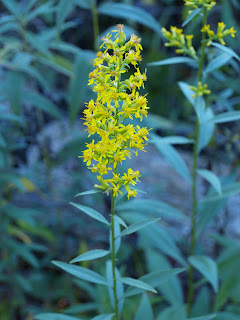
Solidago nemoralis, old-field goldenrod. I think that name is more romantic than its other, gray goldenrod, although you can definitely see in this photo where that name comes from.

Solidago riddellii, Riddell's goldenrod

Solidago rigida, stiff goldenrod

Solidago speciosa, showy goldenrod. It looks like a fairy wand to me.

Solidago ulmifolia, elm-leaved goldenrod, whose leaves look nothing like elm leaves. As an earlier-blooming goldenrod, it's a little past its prime.

Aaaaand Triosteum aurantiacum, orange-fruited horse gentian, whose specific epithet I've been mispronouncing for years. I was gently corrected this summer.
I'll leave you with a photo of one of the prairie openings at SPG...I walked through it with my arms brushing the tops of the Indian grass, like Kevin Costner in Dances With Wolves:

Monday, August 20, 2012
Helianthus crunch session
Yesterday's botany bender/blast/outing was at Somme Prairie Grove. I learned something horrible--there are actually four species (at least) of woodland sunflower in the Chicago region, not just Helianthus divaricatus. I suppose I knew in the back of my mind that these three others--H. strumosus, H. decapetalus, and H. hirsutus--existed, but I figured that since they are distinct species, I would recognize them as being different if I ever saw them. That's pretty much wrong--at first glance, they all look basically the same. Even at a second glance, they look basically the same (and I'm still not so sure that they're not actually one species with a wide range of variation). Luckily, all four "species" exist at Somme Prairie Grove, and site steward Stephen decided to tackle them, with about ten different botanical keys as backup. The distinctions between them boil down to stem roughness and petiole length/leaf dimension:
1. H. hirsutus is immediately distinguishable from the others because it is the only one that is rough/hairy all the way down to the bottom of the stem. They all are (or may be) hairy near the top, but it's the bottom 2/3 that counts. Unfortunately, it seems that the hairs might sometimes fall off the stem later in the season (of course they would, those little bastards). In this case, you can tell that they used to be there because there are dark blemishes on the stem. The leaves have very short or no petioles:

2. H. divaricatus is the only other one with very short or no petioles, but it is smooth lower down on the stem (can't possibly show the lack of hairiness, but here are the petioles):

3. H. decapetalus is also smooth lower down on the stem, but has long petioles, often more than 3cm long. The leaf is generally wide and ovate, less than 3x as long as broad:


It can often be confused with Heliopsis helianthoides...oh, who am I kidding? They all could, but especially this one because of the wide leaves. The trick is looking at the bracts under the inflorescence...they're pointy in all Helianthuses (Helianthi?), but rounded or blunt in Heliopsis:


4. H. strumosus is what they call the "wastebasket" species...it is so variable, that if you can't figure out what species you have, just assume it's H. strumosus. It is also smooth-stemmed down to the bottom with long petioles, like H. decapetalus, but the leaves are longer and narrower (>3x as long as wide) and petioles are slightly shorter (<3cm) and the leaf tends to taper down to a winged petiole like this:

But not all of the ones that we saw tapered like that, so it's not a definite characteristic. The photo below shows the allegedly "longer, narrower" leaves. Nothing you'd ever notice from a galloping horse.

Lord a-mighty! Now that we've strained our brains, let's just look at some pretty pictures:


1. H. hirsutus is immediately distinguishable from the others because it is the only one that is rough/hairy all the way down to the bottom of the stem. They all are (or may be) hairy near the top, but it's the bottom 2/3 that counts. Unfortunately, it seems that the hairs might sometimes fall off the stem later in the season (of course they would, those little bastards). In this case, you can tell that they used to be there because there are dark blemishes on the stem. The leaves have very short or no petioles:

2. H. divaricatus is the only other one with very short or no petioles, but it is smooth lower down on the stem (can't possibly show the lack of hairiness, but here are the petioles):

3. H. decapetalus is also smooth lower down on the stem, but has long petioles, often more than 3cm long. The leaf is generally wide and ovate, less than 3x as long as broad:


It can often be confused with Heliopsis helianthoides...oh, who am I kidding? They all could, but especially this one because of the wide leaves. The trick is looking at the bracts under the inflorescence...they're pointy in all Helianthuses (Helianthi?), but rounded or blunt in Heliopsis:

This is a Helianthus. Who knows which one.

This is Heliopsis. Ta-da!
Also, Heliopsis has toothier leaves:


But not all of the ones that we saw tapered like that, so it's not a definite characteristic. The photo below shows the allegedly "longer, narrower" leaves. Nothing you'd ever notice from a galloping horse.

Lord a-mighty! Now that we've strained our brains, let's just look at some pretty pictures:

Agrostis perennans, thin grass. I've probably walked by this a thousand times thinking it was redtop.

Brachyeletrum erectum, long-awned wood grass.

Cirsium altissimum, tall thistle. Whenever I try to take a picture of the whole plant to show how tall it is, it always turns out like crap. Backlit and muddled by oak trees in the background.

Elymus riparius! I'm finally nailing down these ryes.

We also learned the difference between tall & late bonesets. This is Eupatorium altissimum (tall). Its leaves are long and narrow, and the plant is slightly fuzzy and gray-tinged all over.

(Even the flowers are fuzzy.)

This is the leaf of E. serotinum (late boneset). It's toothier and more egg-shaped.

Its flowers are sharper-looking and not fuzzy.

This is allegedly a hybrid between cream and bottle gentians. Bottle gentian generally blooms much later than this, but it appears to have lent its blue tinge to the cream gentian.

Hedeoma pulgeoides, pennyroyal, in gorgeous full bloom. Look at those itty-bitty flowers! This is one of those plants most people probably just walk right past, because it's tiny and doesn't look like much.

A-ha. This is how you can tell Indian grass before it flowers--this distinctive brown ligule that clasps the stem. I think the narrowing of the leaf blade is also an indicator.

And finally, the state-threatened Tomanthera auriculata, earleaf false foxglove. The ears are those pointy things on the sides of the leaves.
Subscribe to:
Posts (Atom)